An absent player does not have to mean a character vanishes into the mist. A short between-session adventure can explain the separation, provide a personal lead and end somewhere that makes rejoining the party straightforward.
Downtime should support the shared campaign. It need not settle the central conflict or require everyone else to read a long conversation.
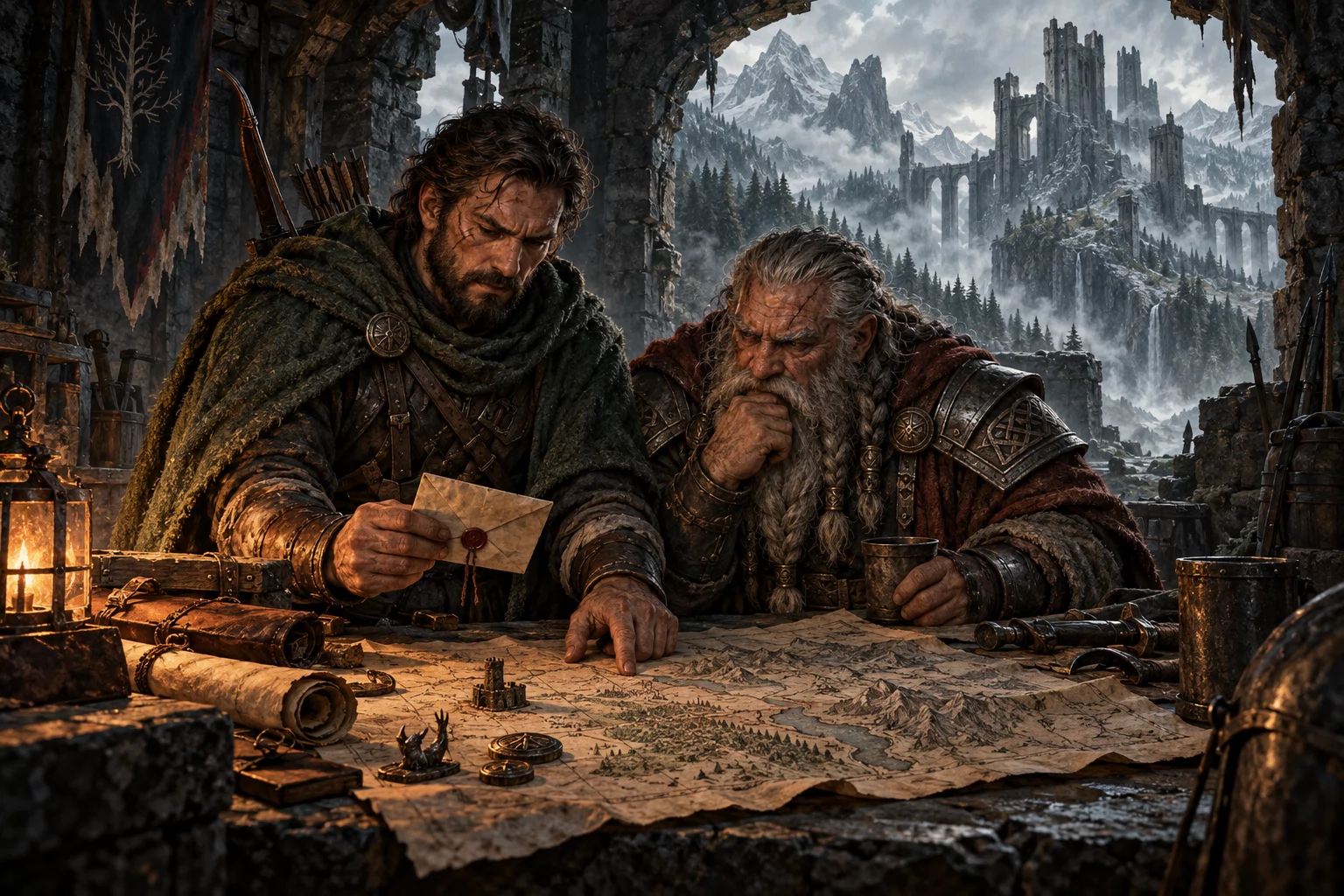
Give it one task and a return condition
Instead of “do something in town,” choose a concrete goal: find an old ally, collect a map or discover who is watching the inn. Add an ending condition: the character rejoins the party before dawn or after receiving an answer.
This bounds the preparation and protects the next session from an accidental change of direction. The player knows what they are pursuing, and the GM can judge whether a proposed outcome fits the brief.
Prepare a small set of material
In Narrative Framework, write an opening scene, one or two characters, a location and a clue. Connect them on the graph. Structural checks help identify missing links; they do not guarantee that a mystery will be solvable at the table.
Keep GM secrets separate. When assigning the adventure, select only material intended for the player. An assignment is a snapshot, so subsequent scenario edits do not rewrite ongoing play.
An absent-character example
The party leaves the port while Arin stays for an evening to find Mira the cartographer. Arin must collect a letter and rejoin the others before the morning ferry leaves.
Boundaries can be concrete: do not settle the guild's fate, kill major characters or gain permanent abilities. Possible consequences include a new contact, a debt to discuss or a lead for the next session. The player has room to make decisions without taking over the campaign's main arc outside the table.
The agent runs the conversation; the workshop stores state
The player connects an external MCP client with a separate play-session token. The agent receives assigned material plus memory and journal tools. The workshop does not include an AI model or chat interface; the chosen client supplies the model.
Memory helps resume the story, while the journal records its progression. This does not guarantee that an agent applies the RPG rules correctly or interprets every boundary well. The GM defines the rules; narrative quality also depends on the client and model.
End with a short report
A few sentences are enough for the shared session: what the character did, what they learned and which consequence needs a GM decision. Lasting effects default to human review. They are not automatically merged into campaign canon.
The same structure works for solo play and downtime for a player who attends every session. Change the goal, boundaries and return condition while preserving a clear record of events.
Read the individual-adventure guide, explore the sample scenario or open the workshop. Shared world knowledge can live in a campaign wiki.